
1. An Ancient Escape from the Modern World
When you turn off Antalya's noisy coastline and enter the peace-filled roads of Finike, you are greeted by a fairytale hidden in the shadow of Mount Toçak. Limyra, where the scent of orange blossoms mixes with the song of cicadas, welcomes visitors not just with piles of stone, but with ice-cold spring waters gushing from the heart of the earth.
In Limyra, time slows down with the flow of the river, inviting you away from the modern world into the silence of centuries past.
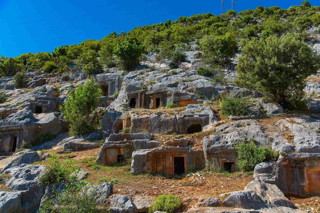
2. A Record-Breaking Necropolis: Over 400 Rock Tombs
Limyra has held the title of the settlement with the most rock tombs in the entire Lycian geography for centuries. More than 400 tombs, meticulously carved into the mountain slopes, date back to those glorious days when the city’s ancient name was mentioned as "Zemuri" in Lycian inscriptions.
"Limyra is the place with the most tombs in the Lycian region. It is known that there are more than 400 rock tombs in the city, many featuring Lycian inscriptions." — Archaeological Field Records
3. The Submerged Roman Road and Mysterious Church
The most important force shaping the city's soul is the Alakır Stream (anciently known as Limyros). After the 10th century AD, rising waters and a shifting riverbed literally froze the heart of the city and carried it to the present day. Today, as you walk through knee-deep icy water, you can see the colonnaded Roman street and the ruins of a church that once served as a bishopric center beneath you.
Noticing an "altar curve" under the clear water creates a sense of touching a living civilization at the bottom of a stream, rather than just reading dusty pages of history.
4. The Story of an Empty Tomb: Gaius Caesar’s Cenotaph
Limyra holds unexpected importance in world political history. Gaius Caesar, the grandson and adopted son of Emperor Augustus, passed away in this quiet city in 4 AD while returning from Jerusalem to Rome. The monumental tomb built here for the young heir is actually a "Cenotaph"—an empty tomb—because his body was taken to Rome, the center of the empire.
5. A Past Built Without Nails: The "Andron" Project
The "Andron" project carried out in Limyra rejects modern methods to understand ancient construction techniques. Here, a structure was built without using any nails, screws, or adhesives, relying solely on the craftsmanship and geometric intelligence of ancient humans. This small hut is a living laboratory showing how human memory is hidden in technical details.
6. The Heart of Politics: Capital of the Lycian League and the Giant Theater
Limyra, which experienced its golden age in the 4th century BC, was one of the six major cities with three voting rights in the Lycian League—considered the world’s first democratic union. This prestigious status is embodied in its massive theater with a capacity of approximately 20,000 people.
"The theater underwent a major repair in 141 AD. We know from inscriptions that the famous benefactor Opramoas provided the aid." — Epigraphic Records
Comfortable Transportation to Limyra: Reaching the Finike - Limyra region from Antalya or the airport can be exhausting, especially during the hot summer months. With Destina Transfer’s luxury VIP vehicles, you can enjoy a comfortable and safe journey to this historic paradise.
7. Conclusion: Limyra’s Silent Invitation
Limyra is a sanctuary that has managed to stay away from the crowds of popular routes. Visiting this ancient city, which lives in the coolness of an icy river rather than dusty rooms, will completely change your perspective on time.